
Rabbits (aka "bunnies"), as most of our Foley families call them, make truly delightful companions. Between their playful "binkies" (the joyous twists they do in mid-air!) and their sweet, quiet personalities, they quickly become part of the family. However, because they are prey animals, they require specialized care centered around their sensitive digestive systems and teeth that never stop growing.
At Schreiber Veterinary Hospital, we see plenty of both house bunnies and outdoor rabbits. We know how important it is to prevent common problems like GI stasis and dental disease before they become emergencies. Whether your furry friend lives indoors with you or enjoys a secure outdoor enclosure in Alabama’s warm climate, this guide gives you everything you need to keep them healthy and happy for years to come.
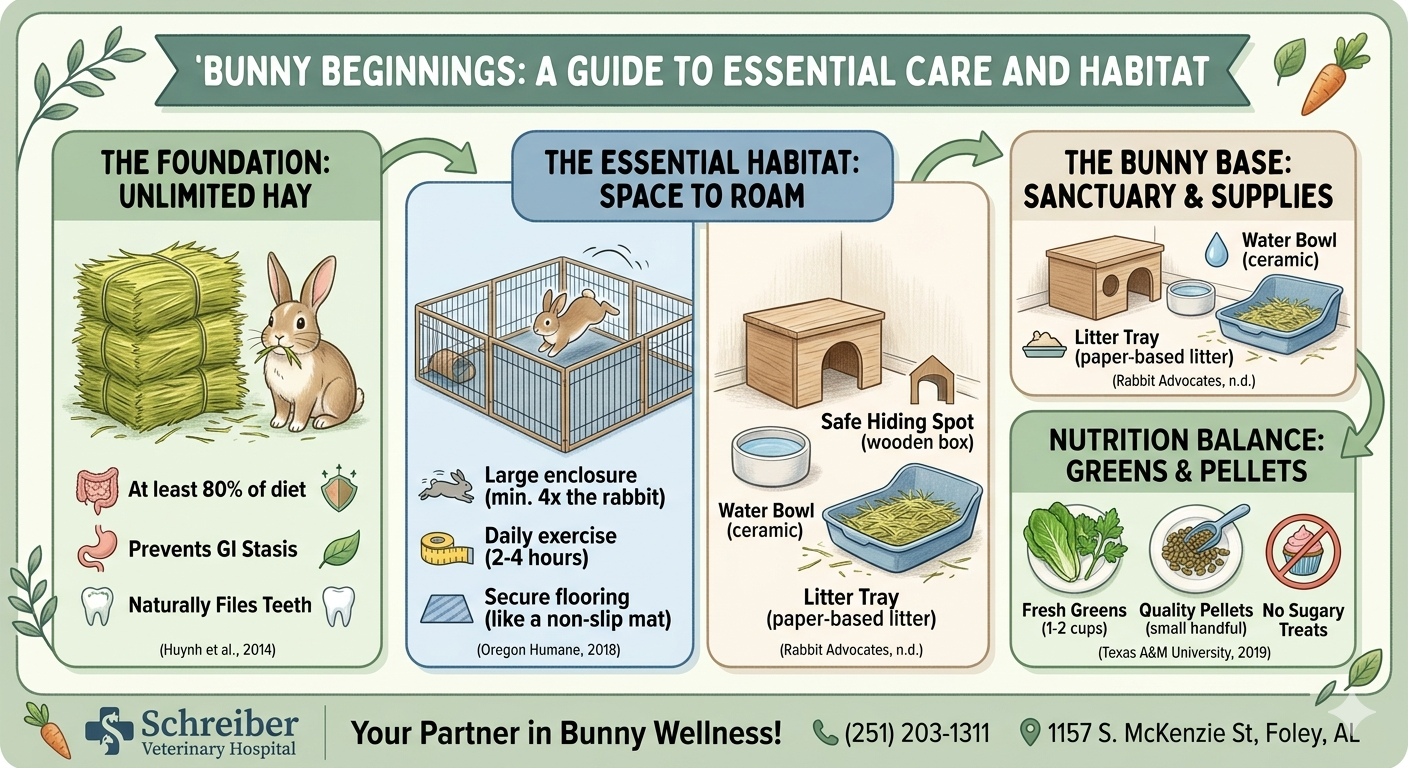
Providing a healthy life for your rabbit goes beyond just providing food and water. To ensure your companion thrives in our Foley community, we will explore the four critical pillars of bunny care:
While these guides are essential, every bunny is unique. Don’t hesitate to contact us at Schreiber Veterinary Hospital for a personalized wellness check or to discuss any specific concerns regarding your rabbit's health.
A bunny’s gut is a biological machine designed for constant grazing. If that machine stops for even 12–24 hours, a condition called GI stasis can hit hard. This slowdown often leads to painful bloating, lethargy, fewer or no droppings, a hunched posture, and even audible teeth grinding—symptoms that can turn serious fast without quick help (House Rabbit Society, n.d.).
A Real-World Example
Take Whiskers (not his real name, we changed it to protect his identity), a fun-loving 3-year-old house bunny whose family had just moved here to Foley. One morning he refused his favorite greens, and by afternoon there was no poop in his tray. His worried owner noticed the lethargy right away and brought him straight to us. After receiving fluids, pain relief, and gentle motility medication, he was back to zooming and munching hay within two days.
Common triggers include the stress of a move, dehydration in our hot Alabama summers, dental pain, or a diet too low in fiber that allows bad bacteria to take over (Laval & Lavoie, 2025; VCA Hospitals, n.d.). The lesson for every owner is simple: unlimited timothy hay, daily checks, and calm routines prevent most cases—and early action saves lives.
A rabbit’s teeth grow a staggering 2–3 mm every single week. They need nonstop wear from fibrous foods like hay, or they quickly become overgrown, painful, and full of sharp "spurs" (Müller et al., 2014). This can stop a bunny from eating completely and even lead to dangerous abscesses. Smaller breeds like Netherland Dwarfs and lop-eared bunnies are especially prone because of their unique head shapes (Netherland Dwarf - Dental Malocclusion, n.d.).
Consider the story of Luna, a sweet lop-eared bunny who came to us with swollen cheeks. She had stopped eating because her incisors had grown so long they were actually piercing her lips. After a careful extraction of the problem teeth under safe anesthesia, she was pain-free and back to her playful self in no time (Lennox, 2008).
Establishing a baseline oral exam between 6–12 months allows us to catch "silent" pain before it becomes an emergency. Watch for these red flags:
Dr. Schreiber recommends professional dental checks around 3-4 years, sooner if your bunny is having any problems. Having a physical exam once a year is also recommended. Feeding a diet of at least 80% high-quality hay naturally files teeth down through constant grinding!
The right diet is your best defense against both stasis and dental trouble. We recommend 80–85% unlimited grass hay (timothy or orchard works great), a small handful of pellets, and 1–2 cups of fresh leafy greens like romaine or parsley (Texas A&M University, 2019). Take the case of Max, an outdoor rabbit who suffered from digestive issues for months on a pellet-only diet. Once his family switched him to a hay-first diet, his digestion normalized in under a week.
Rabbits are naturally tidy! To succeed, place the litter box where the rabbit chooses to go, as they will let you know their preferred spot. Use a large tray with paper-based litter topped with hay. Bunnies like to poop where they eat. Spaying or neutering can help reduce marking and helps bunnies reach 85–99% accuracy in their potties, plus it reduces the musky smell.
Be cautious in weather over 80–85°F, which could cause heatstroke. Watch closely for panting; if your bunny is breathing rapidly through their mouth, move them to a cooler location immediately. Use 16-gauge welded wire for outdoor safety and provide shade and frozen water bottles for cooling if you can't move them to a cooler location.
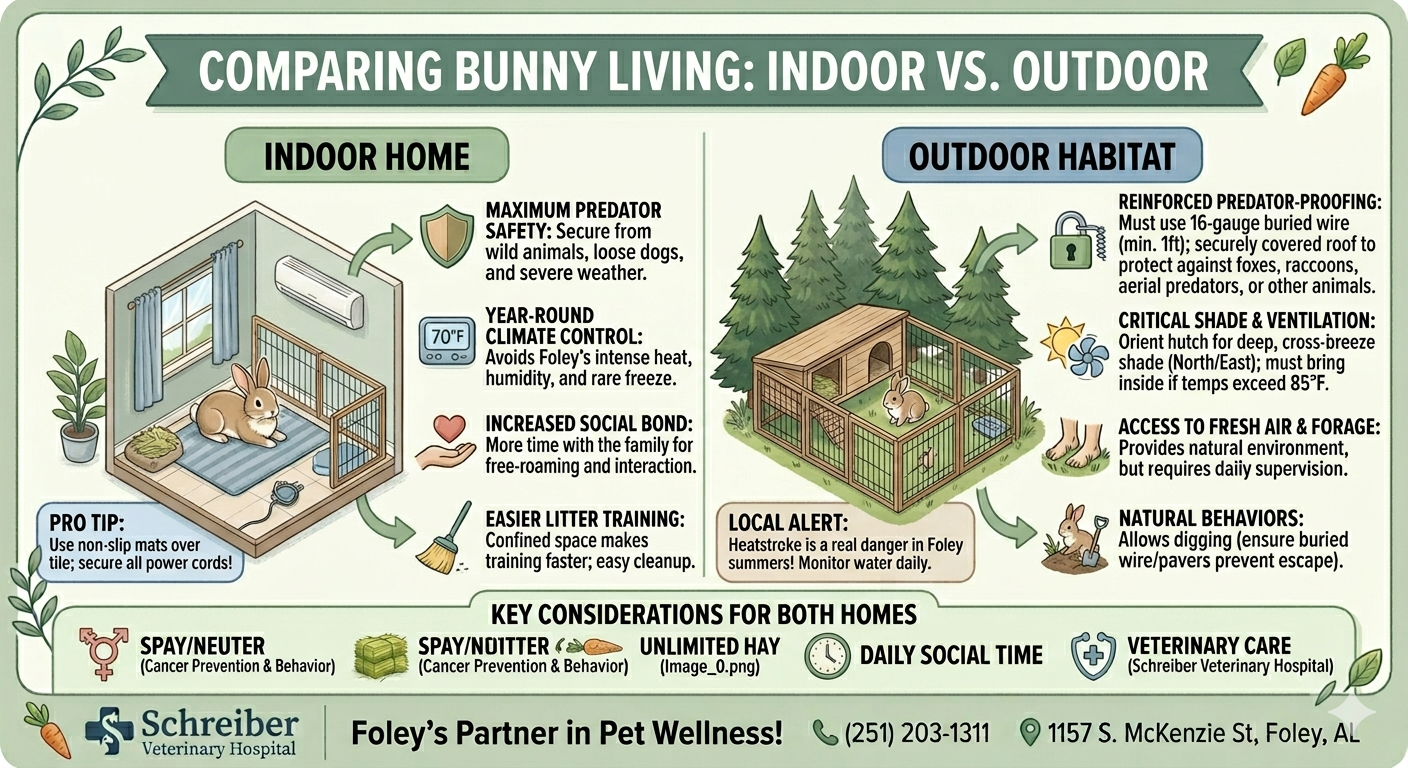
Securing your home for a free-roaming rabbit is a vital step in responsible pet ownership. Before your bunny arrives, walk through your space to identify hazards like loose wires, poisonous plants, or fragile objects. Use this detailed plan to protect your companion and your property.
Electric shock is a major risk.
Prevent structural damage.
Ensure they don't get stuck.
Eliminate poisoning risks.
Before releasing your bunny into their new space, set up a "Bunny Base" with a litter box, fresh water, and a hidey house. Conduct a final check by getting low to the ground to see the room from your rabbit's perspective.
Pro Tip: Always introduce your rabbit to the area under close supervision first. Establish a routine to inspect your bunny-proofed sections to ensure all hardware stays secure!
Unlike towels or rugs, anti-pill fleece is a non-woven fabric. If a rabbit nibbles it, the fabric simply pills or falls apart into tiny, fuzzy bits rather than long, dangerous strings. This prevents the "tangle" effect in their digestive tract. It's also soft on their sensitive hocks, helping to prevent sores (House Rabbit Society, n.d.).
Heading to the store? Here is exactly what to look for to keep your bunny safe:
Ready your home as a bunny paradise.
What are the primary symptoms of GI stasis in rabbits?
The first signs are a refusal to eat (especially favorite treats), lethargy, and a lack of droppings. You may also notice your bunny sitting in a "hunched" position or grinding their teeth in pain. This is a medical emergency.
How do I prevent dental disease in my pet rabbit?
The most effective prevention is a diet made up of 80% high-quality grass hay. The abrasive nature of the hay wears down their teeth, which grow 2-3mm every week (Capello, n.d.).
What should I consider before adopting a rabbit?
Rabbits live 8–12 years typically (we've had 14 year eldar bunnies) and require an annual budget of $500–$1,000 for care. They need daily exercise, "bunny-proofed" spaces to prevent chewing, and are best kept in pairs for companionship.
Spend 60 seconds every morning with your bunny to catch potential health issues before they become emergencies. Know their normal to spot the subtle abnormal!
Watch for the 'Breakfast Dash'. Is your bunny active and excited for their pellets or greens? Or are they 'hunched' in a corner, facing the wall?
Are droppings the normal size, shape, and quantity? Any change (small, misshapen, soft) is an early warning sign.
Gently pet your bunny to feel for changes. Run your hands along their body—feel for new lumps, bumps, or tender spots.
Check Nose & Eyes: are they clear and dry (no discharge)? Gently touch their Ears: are they extremely hot or extremely cold to the touch?
If your bunny 'fails' any of these checks (refuses food, abnormal poop, lethargic),
contact a veterinarian right away. Do not wait.
Schreiber Veterinary Hospital, Foley: (251) 203-1311
At Schreiber Veterinary Hospital in Foley, AL, we offer complete rabbit wellness exams, dental care, and expert treatment.
1157 S. McKenzie St, Foley, AL
Animal Humane Society. (n.d.). Adopting a pet rabbit: What to expect.
Bunny World Foundation. (n.d.). Outdoor dangers for domestic rabbits.
Capello, V. (2016). Diagnostic imaging of dental disease in pet rabbits and rodents. Veterinary Clinics: Exotic Animal Practice.
House Rabbit Society. (n.d.). Bunny proofing: Safety with fabrics and fleece.
House Rabbit Society. (n.d.). Gastrointestinal stasis: The silent killer.
Huynh, M., et al. (2014). Retrospective cohort study of gastrointestinal stasis in pet rabbits. Veterinary Record.
Laval, M., & Lavoie, J. P. (2025). Effect of rabbit gastrointestinal stasis (RGIS) on the fecal microbiota of domestic rabbits. PLoS ONE.
Lennox, A. M. (2008). Diagnosis and treatment of dental disease in pet rabbits. Journal of Exotic Pet Medicine.
Martin, J. L. (2019). Gastrointestinal stasis in the rabbit. Kansas Veterinary Diagnostic Laboratory.
Müller, J., et al. (2014). Growth and wear of incisor and cheek teeth in domestic rabbits. Journal of Experimental Zoology.
Oregon Humane Society. (2018). A guide to bunny-proofing your home.
Rabbit Advocates. (n.d.). Litter training your house rabbit.
Texas A&M University. (2019). Every-bunny watch out for GI stasis. Pet Talk Series.
Universities Federation for Animal Welfare. (n.d.). Netherland Dwarf - Dental Malocclusion.
VCA Animal Hospitals. (n.d.). Feeding your rabbit.